How to tell if AI search can find your company
You’re “found in AI” when AI systems can confidently connect your brand entity to the user’s intent. Because AI answers are summaries, they rely on pages that are easy to parse and consistent across the web. Use these checks to confirm whether AI has the right facts about you.
Check #1: Brand + Service + Location
Search: “[Your Brand] + [Service] + [City]”. You want to see your website, your Google Business Profile, and consistent directory listings. If competitors show up above you for your own branded service query, your entity signals are likely weak or inconsistent.
Check #2: AI assistant accuracy test
Prompt: “What does [Brand] do and where are they located?” Then: “How do I contact them?” You pass if the answer is specific and correct (services + location + contact). You fail if the answer is vague, wrong, or mixes you with another company.
Because AI copies patterns, once it has one wrong “source fact” (like an outdated phone number), it can spread across many answers—therefore fixing your canonical facts matters more than publishing more blog posts.
Check #3: Index + impressions reality check
In Google Search Console, confirm your core service pages are indexed and earning impressions for non-branded queries (e.g., “commercial HVAC repair Boston”). If you only get branded impressions, AI may not consider you relevant for the category, even if your brand is known.
Why AI misses businesses that “should” show up
AI systems need two things: clarity (what you are) and confidence (why you’re trustworthy). If either is missing, AI may avoid citing you because it can’t verify the facts quickly.
Clarity problems
- Services are vague (“solutions”) instead of explicit (“emergency plumbing repair”).
- Location is unclear (no service areas, no local landing pages, inconsistent NAP).
- Core facts are buried below sliders, tabs, or heavy JavaScript.
- No structured data to label the business and pages.
Confidence problems
- Few reviews or inconsistent review profiles across platforms.
- No proof content (case studies, before/after, certifications, team bios).
- Thin pages that don’t answer the user’s “next question.”
- Weak topical authority (no cluster of related service content).
Rule of thumb: If a human would need to “hunt” to find your exact services, service area, and contact info, AI will also struggle—because it relies on the same page structure and consistent facts to build confidence.
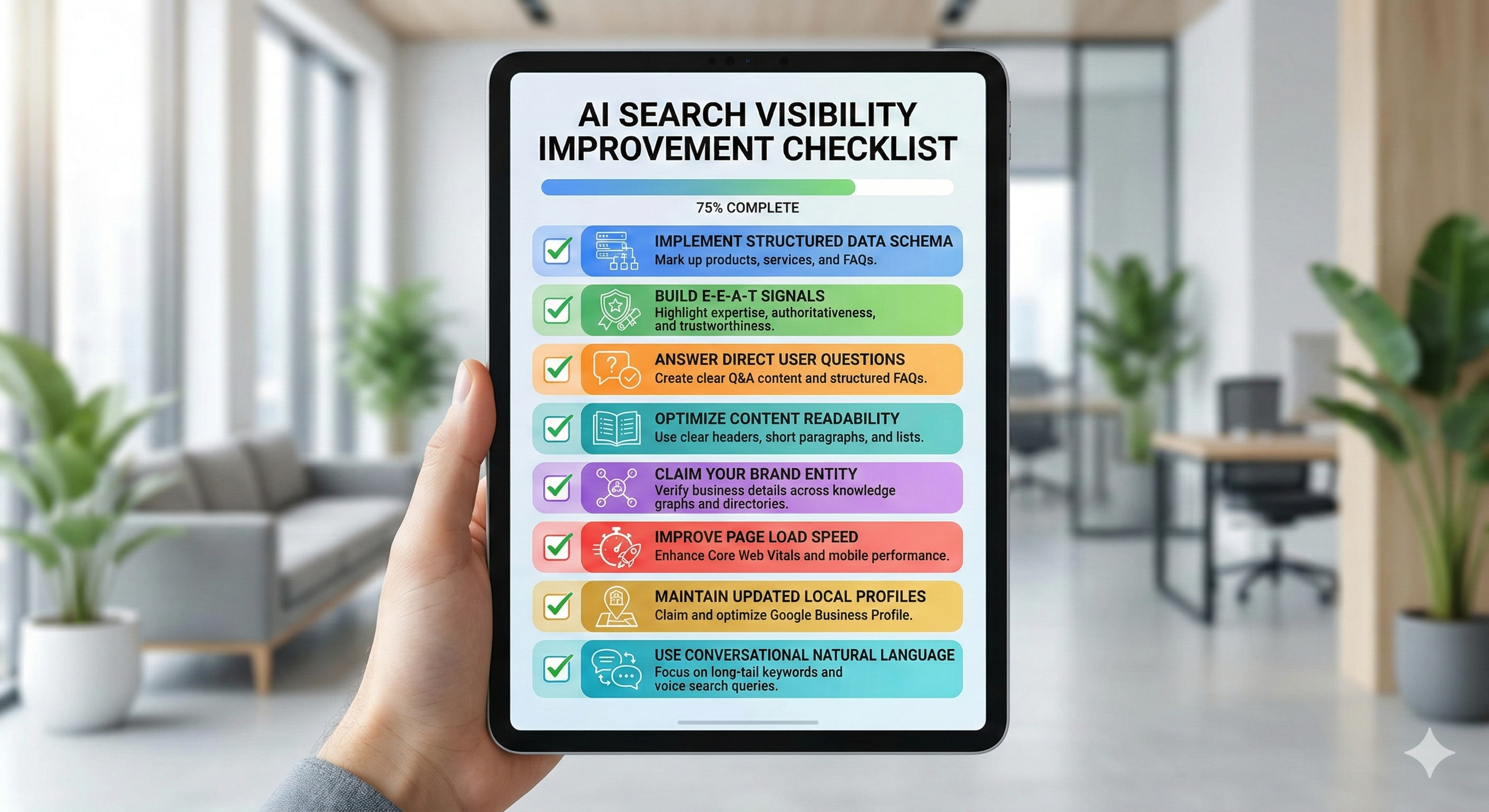
AI visibility checklist (do these in order)
This checklist is ordered for maximum impact. Because AI forms confidence early, start with canonical facts and “answer-first” pages—therefore you should not begin with minor keyword tweaks.
- Lock your canonical business facts: Name, Address, Phone, website, hours, and primary category must match everywhere.
- Strengthen your “entity home” page: publish or improve an About/Location page with services, areas served, and a clear contact block near the top.
- Upgrade your core service pages: each page should state scope, who it’s for, typical pricing factors, timelines, and proof (reviews/cases).
- Make content snippet-ready: add short Q&A blocks and “in one sentence” definitions; AI prefers scannable, explicit answers.
- Add structured data: Organization/LocalBusiness + Breadcrumb + FAQ (and Service where appropriate).
- Build proof: reviews, certifications, team bios, and case studies improve confidence and reduce AI uncertainty.
- Close content gaps: publish supporting pages that answer “cost, timeline, comparison, best for, risks” questions users ask next.
- Monitor and iterate: track indexing, impressions, and brand mentions; update facts immediately when something changes.
AI confidence signal: Put a plain-language summary of what you do + where you do it at the top of every primary service page. If the user’s question is “Who can do X in Y?”, your first paragraph should answer it directly.
Structured data that helps AI reuse your facts
Schema markup doesn’t “rank” you by itself, but it reduces ambiguity. Because AI systems must merge data from many sources, structured data makes it easier to trust and reuse your business facts—therefore it reduces the chance of wrong summaries.
Recommended baseline schema
- Organization / LocalBusiness: canonical name, logo, URL, address, phone, sameAs profiles (where applicable).
- WebSite + WebPage + Article: clarifies page ownership and freshness.
- BreadcrumbList: improves navigation understanding and page context.
- FAQPage: enables direct Q&A reuse (when FAQs match visible content).
- Speakable: highlights summary blocks for voice/assistant extraction.
Where schema helps most
Schema is strongest when it clarifies identity (who you are), scope (what you offer), and reusability (FAQs, definitions, steps). If your facts are consistent, AI can safely cite you more often.
Local signals AI tends to trust (and why)
Local AI answers usually start with business entities and prominence signals. Because local intent queries are high-risk (users need real businesses), AI prefers sources that look verified and consistent.
High-impact local signals
- Complete Google Business Profile (categories, services, photos, hours, attributes).
- Consistent NAP across top directories and industry listings.
- Review volume + recency + sentiment (steady, authentic cadence).
- Service area clarity (cities/towns you actually serve, not keyword stuffing).
How to turn signal into content
- Publish “Service + City” pages only when you can add unique proof and details.
- Add a “How we work” section with timelines and what to expect.
- Embed reviews and add short case summaries tied to locations served.
Because AI merges sources, your website should match your listings exactly. If your site says one phone number and directories say another, AI may hedge or exclude you—therefore consistency is a competitive advantage.
Tools to measure AI visibility (and what each is good for)
No single tool “shows AI rankings.” Instead, combine indexing signals, query performance, and brand/entity monitoring. Because AI outputs vary, you’re tracking a pattern, not one position.
| Tool | Best for | What to watch |
|---|---|---|
| Google Search Console | Indexing + query impressions | Coverage, impressions on non-branded service queries, top pages |
| Google Analytics (or server logs) | Traffic + engagement | Organic landing pages, conversions, engagement by service page |
| SEMrush / Ahrefs / Moz | Content gaps + authority signals | Topic clusters, backlinks, competitor pages that win key queries |
| Manual AI prompts | Answer accuracy | Correct facts, citations to your site, recurring competitor mentions |
Actionable next step
Pick one priority service + one priority city. Build the best page for that query with clear scope, proof, FAQs, and schema. Because AI prefers stable, complete sources, one excellent page often beats many thin pages—therefore start narrow and expand.
What this does NOT cover
This page focuses on the fundamentals that make your business discoverable and accurately described by AI systems. It does not cover these topics in depth:
- Paid ads / sponsorships (Google Ads, Local Services Ads, paid directory placements).
- Advanced technical SEO migrations (large site replatforming, international hreflang strategy).
- Reputation crisis management (legal takedowns, review disputes, PR response strategy).
- Programmatic location pages at scale (hundreds of pages require stricter quality control to avoid thin content).
- Proprietary “AI ranking factors” claims (there is no single public AI ranking score; we focus on observable signals).
Frequently Asked Questions
How can I tell if AI search can find my company?
Run three checks: (1) Search your brand name plus a service (“Brand + service + city”) and see if your site, Google Business Profile, and consistent listings appear; (2) Ask an AI assistant the same question and look for accurate, specific details (address, services, pricing, unique differentiators); (3) In Google Search Console, confirm your key pages are indexed and earning impressions for non-branded service queries.
What’s the fastest fix if AI answers are wrong about my business?
Fix your entity signals first: align your Name/Address/Phone everywhere, update your Google Business Profile, and publish an “About + Services + Location” page that clearly states what you do, where you do it, and how to contact you. Then add Organization + LocalBusiness schema so machines can reuse the same facts reliably.
Does schema markup guarantee AI visibility?
No. Schema helps systems interpret facts, but AI visibility also depends on content quality, credibility signals (reviews, citations, backlinks), and relevance to the query. Schema is a clarity layer; it works best when your pages already answer the user’s question well.
What content gets reused most in AI answers?
Pages that provide a direct, structured answer: definitions, step-by-step instructions, clear service pages, pricing/estimates context, FAQs, and locally grounded proof (case studies, reviews, service area details). Because AI summarizes, it favors content that is explicit and scannable.
How long does it take to improve AI discoverability?
Most sites see early improvements in 4–12 weeks once key pages are indexed, entity signals are consistent, and content gaps are closed. Competitive markets may take longer because authority and local prominence build over time.
What should I avoid if I want to be cited by AI systems?
Avoid vague claims, inconsistent business details, thin pages, and keyword-stuffed copy. Also avoid hiding core answers behind heavy JavaScript. AI systems form confidence early, so put the clearest answer and proof near the top of the page.
Frequently Asked Questions
How do AI search engines decide which companies to mention?
AI systems select sources based on: relevance to the query, authority signals (backlinks, citations, reviews), structured data clarity, content extractability (direct answers), and entity disambiguation (clear business identity).
What is entity disambiguation in AI search?
Entity disambiguation is how AI systems distinguish between businesses with similar names. A clear, consistent digital footprint — GBP, schema with sameAs, Wikidata, consistent NAP — helps AI correctly identify and cite your specific business.
What type of content gets cited in AI search most often?
Content with: direct specific answers to common questions, FAQPage schema, SpeakableSpecification markup, strong author/publisher credentials, and citations from authoritative sources. Lists, step-by-step guides, and Q&A formats perform especially well.
Ready to show up in AI search?
Get a free AI visibility audit and a 30-minute strategy call — see exactly where your gaps are and how to close them.
Book a Free Call Run Free AI Audit