
TL;DR (Quick Answer)
- AI Overviews answer a growing share of searches; organic CTR often drops when they appear.
- Being cited in AI answers is the new visibility lever. Use TL;DRs, lists, FAQs, tables, and schema.
- Start with clear Q&A sections, FAQPage + Speakable schema, and a short TL;DR on top of key pages.
1) What Are AI Citations?
An AI citation is when your site is referenced as a source inside an AI-generated answer (e.g., Google’s AI Overview box). It’s becoming the new “prime real estate” above the traditional results.
Learn how we evaluate this in a quick AI Visibility Review, or try the AI Search Visibility Audit Tool.
2) Why Organic CTR is Falling
Independent studies have recorded lower organic CTRs when AI Overviews appear on a query.
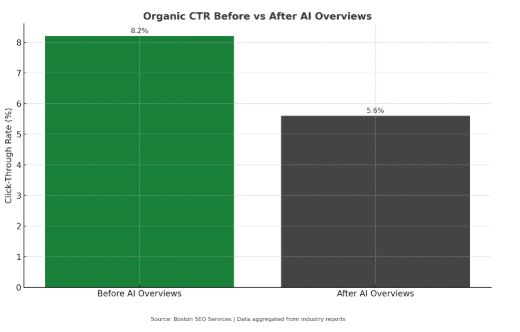
“In the age of AI search, the #1 spot isn’t the top anymore.”
3) Industries Feeling the Impact
Some sectors see larger changes (e.g., travel, recipes, e-commerce) because answers are easy to summarize in an overview.
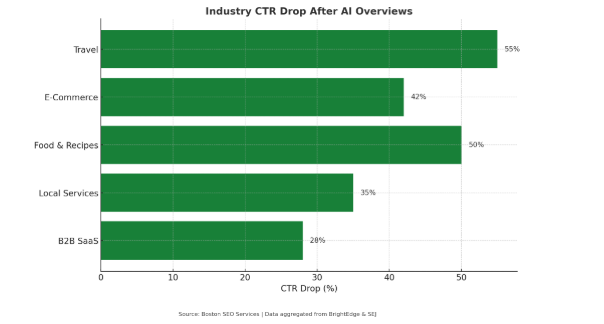
Local providers can still compete with structured pages and reviews. See our notes on schema and internal linking in this short primer on Local SEO for service businesses.
4) How the Citation Funnel Works
Getting into the AI answer is step one; earning the click is step two. Think of it as a funnel:
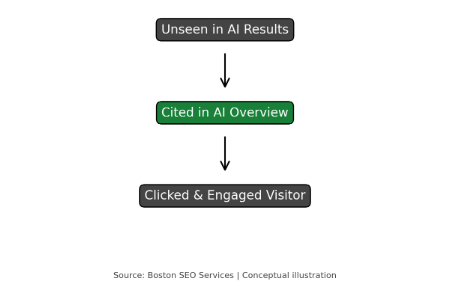
- Unseen — no presence in the AI box.
- Cited — your brand is referenced as a trusted source.
- Clicked — the user engages because your snippet promises detail and clarity.
Use a quick SEO audit to identify which pages should become your “AI answer” hubs.
5) What Business Owners Can Do Now (Non-Technical)
- Add structure: TL;DR at top, short sections, lists, and tables.
- Layer schema: Article, FAQPage, LocalBusiness, and Speakable.
- Answer like a person: write one-to-two-sentence answers to your top questions.
- Cite sources & stats: AI frequently favors fact-rich, well-sourced pages.
- Track “citation rate” in addition to rankings (how often your brand is referenced in answers).
For deeper tactics (entity signals, internal linking patterns, and GEO/AEO), see: Generative Engine Optimization (GEO) and Answer Engine Optimization (AEO).
6) FAQs
Do AI Overviews reduce organic clicks?
Yes. Multiple studies show meaningful CTR declines when AI Overviews appear on a query, with variation by industry.
Can small businesses earn AI citations?
Yes. Clear structure, schema, and concise answers help niche sites win citations over larger brands.
What should I change on my pages right now?
Add TL;DR summaries, a short FAQ, lists, and schema. Keep answers short, accurate, and easily quotable.
Final Word
AI citations are a right-now visibility factor. Businesses that adapt with clear structure, concise answers, and reliable signals will show up more often in AI answers — and win more qualified clicks.
If you’re not in the AI answer, you’re invisible.